
Dixie Alley Tornado Preparedness: Your Garage Door Guide
On April 27, 2011, 62 tornadoes touched down across Alabama in a single day. The Tuscaloosa-Birmingham tornado alone killed 65 people and stayed on the ground for 80 miles. It’s one of the deadliest tornado events in American history, and it happened here.
Alabama isn’t on the edge of tornado country. We’re in the heart of one of the most dangerous tornado corridors on earth. Your garage door is part of your storm preparation, whether you’ve thought about it that way or not.
Why Dixie Alley Is Different
Most people know about Tornado Alley, the corridor through Texas, Oklahoma, Kansas, and Nebraska. Dixie Alley is different. In many ways, it’s more dangerous.
Nighttime tornadoes happen more often here. Plains storms tend to form in the afternoon when you can see them coming. Alabama tornadoes frequently strike at night when radar is your only warning.
Terrain and tree cover hide tornadoes. The open plains give you miles of visibility. Alabama’s hills and forests can hide a tornado until it’s less than a mile away.
The season runs longer. Oklahoma peaks in May and winds down. Alabama has serious tornado threats in spring and again in the fall, with a secondary peak in November and December.
Violent tornadoes are more common here relative to total count. The 2011 super outbreak produced multiple long-track EF4 and EF5 tornadoes in a single day. There’s nothing equivalent in recent Plains history.
The Garage Door Is the Weakest Point
Engineers who study tornado damage say the same thing consistently: the garage door is where failures start.
A standard residential garage door is a large, thin panel spanning a wide opening in your home’s exterior wall. Most aren’t built to resist high winds. When one fails in a strong storm, it creates a sudden pressure change inside the house that can accelerate structural damage dramatically.
The sequence goes like this: wind loads the door beyond capacity, it buckles inward, pressure spikes inside the structure, and the roof and walls take simultaneous stress they weren’t designed to handle. Roof failure becomes much more likely.
Florida requires wind-rated garage doors in most new construction because of hurricane risk. Alabama codes aren’t uniformly that strict. Many homes here have standard residential doors with no wind resistance rating at all.
Wind-Rated Doors: What the Numbers Mean
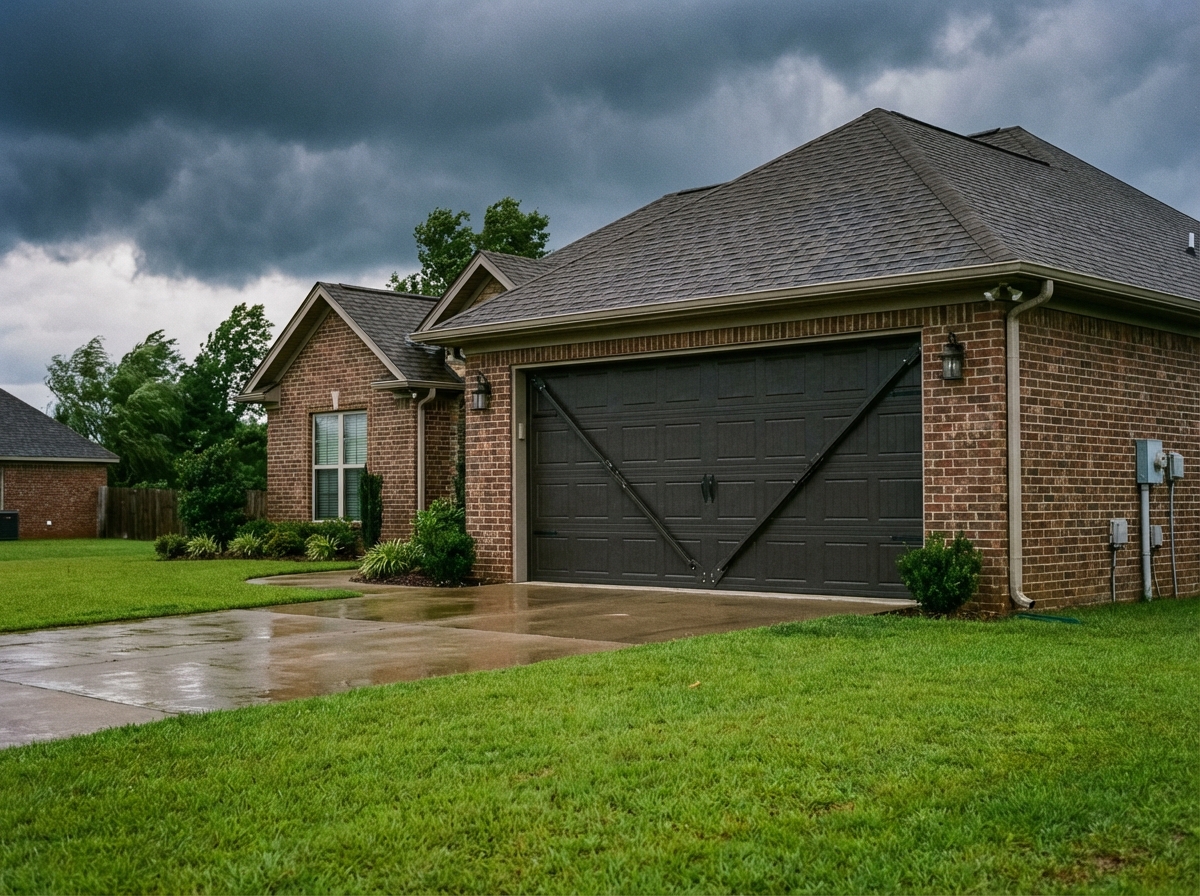
130 MPH rated doors meet the minimum requirements for most of Alabama’s wind design zones. This handles strong EF2 winds and most severe thunderstorm downdrafts. Most new construction in Alabama should meet at least this standard.
150-160 MPH rated doors provide meaningful protection into EF3 winds and the lower end of EF4 intensity. Worth considering if you’re in an area with a history of violent tornadoes, or if your home sits in an exposed location with no natural windbreaks.
Wind-rated doors get their strength from heavier gauge steel, reinforced horizontal stiffeners (the ribs you see on the door face), and heavier track and hardware systems. They won’t survive a direct EF5 hit, but they dramatically reduce the risk of early failure in the EF1-EF2 range that causes most wind damage in Alabama.
One thing I can’t stress enough: a wind-rated door is only as strong as its installation. The track, hardware, and door frame mounting all have to be part of the wind-rated system. This isn’t a DIY job.
Bracing for Existing Doors
If you have a standard door and aren’t ready to replace it, bracing kits add horizontal steel or aluminum members to the inside of the door to increase wind resistance.
Bracing isn’t the same as a purpose-built wind-rated door. It improves performance in moderate wind events but won’t replicate a properly engineered system. Think of it as a supplement.
If your door is more than 15 years old, bracing may not even be appropriate. Worn hardware won’t transfer loads well through a brace system.
Before the Storm
Have this done before a watch is issued, not during:
Know your door’s condition. A door that sticks, moves unevenly, or grinds is already compromised. Worn hardware won’t perform at rated capacity.
Close it and latch it when a storm is imminent. A door caught at mid-travel during high winds is extremely vulnerable. Close it and confirm it’s down.
If you’re sheltering somewhere else, manually lock the door. The slide lock or T-handle lock, if your door has one, adds a latch point that doesn’t rely on the opener mechanism.
Know where your actual shelter is. Your garage is not a tornado shelter. A garage with a large door opening is the last place you want to be. Know your interior safe room before tornado season, not during it.
After a Tornado: What to Check
Don’t assume the door is fine because it looks intact from the outside.
Check for racking. High winds can shift a door frame without obvious visible damage. A door that doesn’t open smoothly, or new gaps that weren’t there before, can mean structural movement. Get it professionally assessed.
Inspect all hardware. Hinges, rollers, cables, the bottom section. Debris impact damage isn’t always obvious from a distance.
Check the opener disconnect. High winds occasionally trigger the emergency release. Verify the door is properly re-engaged before relying on automatic operation.
Don’t force a door that won’t open. Bent tracks or a racked frame can cause sudden cable snapping or uncontrolled movement. Call for service.
Photograph everything before repairs. This matters for your insurance claim.

Insurance After Storm Damage
Garage door damage from named storms and tornadoes is typically covered under standard homeowner’s insurance.
Get a written estimate, not a verbal one. Adjusters work from documentation. A detailed written estimate from a licensed garage door company carries real weight.
Know your deductible before storm season. Many Alabama policies have separate wind/hail deductibles, often 1-2% of the home’s insured value, that are much higher than the standard all-perils deductible.
Don’t wait for a tornado warning to find out what your garage door is rated for. Call Garage Door Service 365 at (256) 555-0365 for a wind resistance assessment and to discuss storm-rated upgrades.
Content strategy and SEO by Optymizer
Need help? Our Alabama team is here.
Licensed and insured. Available 24/7. Same rates day or night.
Garage Door Service 365
Alabama Licensed Contractor serving Huntsville and statewide. 15+ years of experience. Licensed, bonded, and insured.